
DEAL FLOW LAB
New here?
If you’d like context, begin with
Why Trust-First Monetization Exists
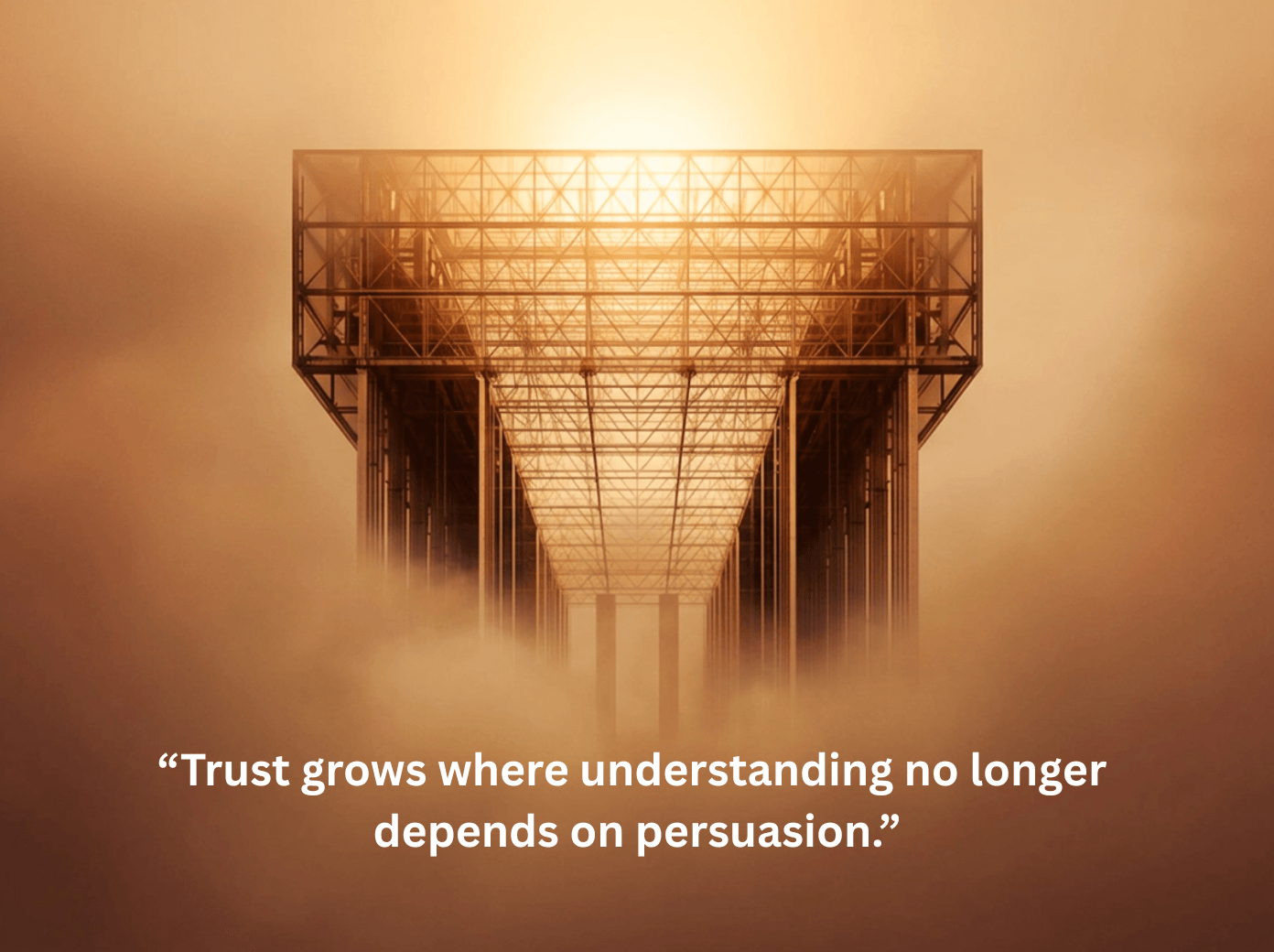
Note #7:
— Trust Is a Property of Structure
Why Trust Cannot Be Manufactured Through Persuasion
Trust is often discussed as though it were something a business creates.
Teams are instructed to build trust.
Marketers are told to increase trust.
Sales professionals learn techniques designed to generate trust more quickly.
But this assumption deserves examination.
Because if trust depends entirely on the actions of an individual, it becomes fragile by definition.
It must be continuously maintained.
Continuously demonstrated.
Continuously reinforced.
The moment attention disappears, trust begins to weaken.
This creates a hidden dependency.
The system becomes dependent on the constant performance of trust.
Many modern business models assume:
Visibility creates trust.
Content creates trust.
Authority creates trust.
Relationships create trust.
As long as the operator remains visible, active, and persuasive, trust remains closely tied to their presence.
When that presence is removed, trust often weakens as well.
The structure itself is not carrying the trust.
The person is.
The Difference Between Personal Trust and Structural Trust
Trust can emerge from many sources.
A person may trust an expert because of demonstrated competence.
A client may trust a consultant because of previous results.
A customer may trust a company because of its reputation.
These forms of trust are not inherently problematic.
But they all share one characteristic:
They are attached to a person, organization, or historical outcome.
Trust remains dependent on factors outside the structure itself.
Structural trust operates differently.
It emerges when the logic of a system becomes visible and understandable.
When people can clearly see:
how the system functions
what assumptions it operates on
what responsibilities belong to whom
what outcomes can reasonably be expected
and how decisions are made
uncertainty begins to decrease.
The need for persuasion decreases with it.
Trust is no longer being requested.
It is being supported by clarity.
Visibility Is Not the Same as Trust
Many systems confuse visibility with trust.
The logic appears reasonable at first.
If people see more of the operator, they will trust more.
If people see more content, they will trust more.
If people see more expertise, they will trust more.
Sometimes this works.
But visibility alone does not create trust.
Visibility merely increases exposure.
Trust depends on what becomes visible.
A visible contradiction does not increase trust.
A visible inconsistency does not increase trust.
A visible dependency does not increase trust.
Visibility amplifies what already exists.
When structure lacks coherence, visibility reveals the weakness.
When structure possesses coherence, visibility reveals the strength.
For this reason, transparency alone is not the source of trust.
Transparency reveals whether the structure is trustworthy.
Why Pressure Weakens Trust
Persuasion attempts to close uncertainty through influence.
Structural trust reduces uncertainty through understanding.
These are fundamentally different approaches.
When pressure enters a decision process, attention shifts.
Instead of evaluating the system, people begin evaluating the pressure.
Questions emerge:
Why must I decide now?
Why is additional influence necessary?
What am I missing?
The structure loses center stage.
The persuasion mechanism becomes the focus.
This does not necessarily prevent a sale.
But it changes the foundation upon which the decision rests.
Trust-First architecture seeks a different outcome.
not to remove decision-making,
but to remove unnecessary pressure from the decision itself.
Understanding performs work that persuasion would otherwise attempt to replace.
Trust Cannot Be Added Later
One of the most common design mistakes is treating trust as a final layer.
The system is built first.
Trust mechanisms are added afterward.
Additional testimonials.
Additional authority signals.
Additional proof.
Additional persuasion.
But trust does not behave like decoration.
It behaves more like load-bearing architecture.
It influences how the entire structure performs.
If trust is absent from the underlying logic, adding more signals rarely solves the problem permanently.
The symptoms may improve.
The foundation remains unchanged.
For this reason, Trust-First architecture begins with a different question.
Not:
“How do we increase trust?”
But:
“How must the structure operate if trust is expected to emerge naturally?”
The answer influences every layer that follows.
A Different Way To Think About Trust
Perhaps trust is not something that can be manufactured.
Perhaps it is something that emerges when contradictions disappear.
When expectations become clear.
When responsibilities become visible.
When incentives remain aligned.
When understanding becomes possible.
When pressure becomes unnecessary.
At that point, trust no longer depends primarily on performance.
It becomes supported by the structure itself.
And a system capable of carrying trust structurally becomes less dependent on constant persuasion to function.
That possibility is what Trust-First architecture exists to explore.
Reflection Question
If trust disappeared the moment the operator stopped persuading, was trust ever located in the structure at all?
What Happens Next
Trust is a property of structure — not persuasion.
But if trust requires structure, then understanding must come before access.
Because without understanding, the structure cannot be evaluated.
And without evaluation, trust has no foundation.
Next: Note #8 — Why Understanding Must Precede Access
info@dealflowlab.com
Created with ©systeme.io